
Lower the pressure. Keep the learning.
A PDA student can want to learn and still be unable to meet the demand in front of them. This practical hub helps school teams notice the load, reduce threat and build access around trust, autonomy and safety.
- Australian context
- PDA-aware
- For schools and families

Look beneath the behaviour
The behaviour is the surface. Look for the load.
When participation drops, begin with curiosity. A nervous-system response can look like refusal, avoidance, control, perfectionism or sudden escalation. The useful question is not simply “How do we make them comply?” but “What is making access feel unsafe?”
Demand density
Instructions, transitions, social rules, time pressure and sensory input can stack up long before anyone sees distress.
Uncertainty
A changed teacher, unclear task or open-ended instruction can make an ordinary lesson feel unpredictable and unsafe.
Loss of control
Being corrected, hurried or given a disguised choice can intensify threat even when the request seems small.
Sensory load
Noise, lighting, movement, uniforms and crowded spaces can quietly use the capacity needed for learning.
Social exposure
Public praise, being singled out, group work or fear of getting it wrong may add more pressure than adults realise.
Masking and recovery
A student may look composed at school while paying for participation through shutdown, distress or exhaustion later.
Regulation before participation
Change the conditions before asking for more capacity.
When a student’s threat response is rising, more instruction, consequence or persuasion usually adds load. Lowering pressure is not lowering expectations forever. It creates the conditions in which thinking, connection and learning can return.
Read: school strategies that work ↗- 1Notice
Look for rising load, not just the final behaviour.
- 2Lower
Reduce words, urgency, audience and non-essential demands.
- 3Offer control
Make space for a real choice, pause, exit or alternative route.
- 4Reconnect
Repair privately and plan the next attempt without shame.
Practical classroom support
Keep the learning goal. Flex the path into it.
The most useful strategies reduce unnecessary threat while keeping the student connected to learning, dignity and their classroom community.
Language & instructions
Invite, preview and make room
- Use collaborative language: “Could we…?”, “I wonder if…?” or “Which part feels possible?”
- Preview non-negotiables early and be honest about where choice is available.
- Allow processing time without repeating, escalating or adding an audience.
Tasks & assessment
Keep the goal; flex the route
- Offer meaningful choices in order, format, location, partner or method of response.
- Break entry into a tiny first step and reduce visible workload where needed.
- Accept different ways to demonstrate learning when the standard format blocks access.
Environment & exits
Build safety before it is urgent
- Agree on a low-key break signal and a predictable place to regulate.
- Reduce sensory and social exposure without making the student explain in public.
- Plan a respectful return so taking a break does not create another barrier.
Reasonable adjustments
Change access, not just the location of the same pressure.
An adjustment is useful when it changes the student’s actual access and participation. Build it from consultation, the student’s experience and the functional barrier—not from a generic list alone.
Australian guidance for educators ↗- 01Curriculum
Reduce repetition, prioritise essential learning, use interests and vary how a task is entered.
- 02Assessment
Offer alternative formats, extra processing time, a quieter setting or staged completion.
- 03Environment
Adjust seating, noise, lighting, uniform expectations, group size and access to regulation spaces.
- 04Timetable
Use flexible starts, planned recovery, reduced transitions or a temporary priority timetable.
- 05Communication
Name a trusted adult, preview change, reduce public correction and document agreed low-demand language.
One shared picture
Bring home, school and student knowledge together.
Different presentations do not cancel each other out. A useful plan holds the student’s voice, classroom observations and the family’s view of recovery in the same conversation.
“What is this environment costing the student—and what changes that cost?”
- 01Student voice
What feels hard, safe, useful or important from the student’s perspective?
- 02The school picture
What happens before, during and after difficult moments across settings and staff?
- 03The family picture
What recovery, distress or loss of function appears before or after school?
- 04What already helps
Which people, words, routines, environments and interests make access more possible?
- 05Early warning signs
How will adults recognise rising load before behaviour becomes the only signal?
- 06One shared response
Who does what, how will it be communicated and when will the plan be reviewed?
When attendance becomes hard
Treat school avoidance as information, not a character flaw.
Persistent difficulty getting to or staying at school can signal that the current demand, sensory or social load exceeds available capacity. Begin with safety and understanding, then rebuild access at a pace the student can sustain.
- 1Stabilise
Reduce immediate pressure, protect connection and stop every conversation becoming a battle about attendance.
- 2Understand
Map the demands, sensory and social load, safety, masking and recovery pattern across the whole week.
- 3Rebuild access
Co-design a gradual, flexible return around safety, trusted relationships, interests and an agreed exit plan.
Discuss flexible attendance, distance or hybrid options and other education pathways available in your state or territory. Keep the student’s wellbeing, voice and right to education central.
Free school downloads
Put the next useful tool in someone’s hands.
Free, printable PDA Australia resources. No signup required.
PDA Schools Quick Reference
A concise starting point for school teams who need the core principles at a glance.
Free PDFDownload ↗PDA School Strategies Card
Keep practical low-demand language and classroom responses close at hand.
Free PDFDownload ↗Low-Demand Classroom Checklist
Review routines, language, choices, transitions and regulation supports in one place.
Free PDFDownload ↗Teacher Meeting Prep Pack
Organise observations, priorities and questions before a home–school meeting.
Free PDFDownload ↗Jekyll & Hyde: An Explainer for Schools
Understand why school presentation and after-school distress can both be true.
Free PDFDownload ↗School Refusal Guide for PDA Families
A practical guide for responding when attendance has become difficult or unsafe.
Free PDFDownload ↗Need something more specific? Browse the complete free resource library.
View all free resources →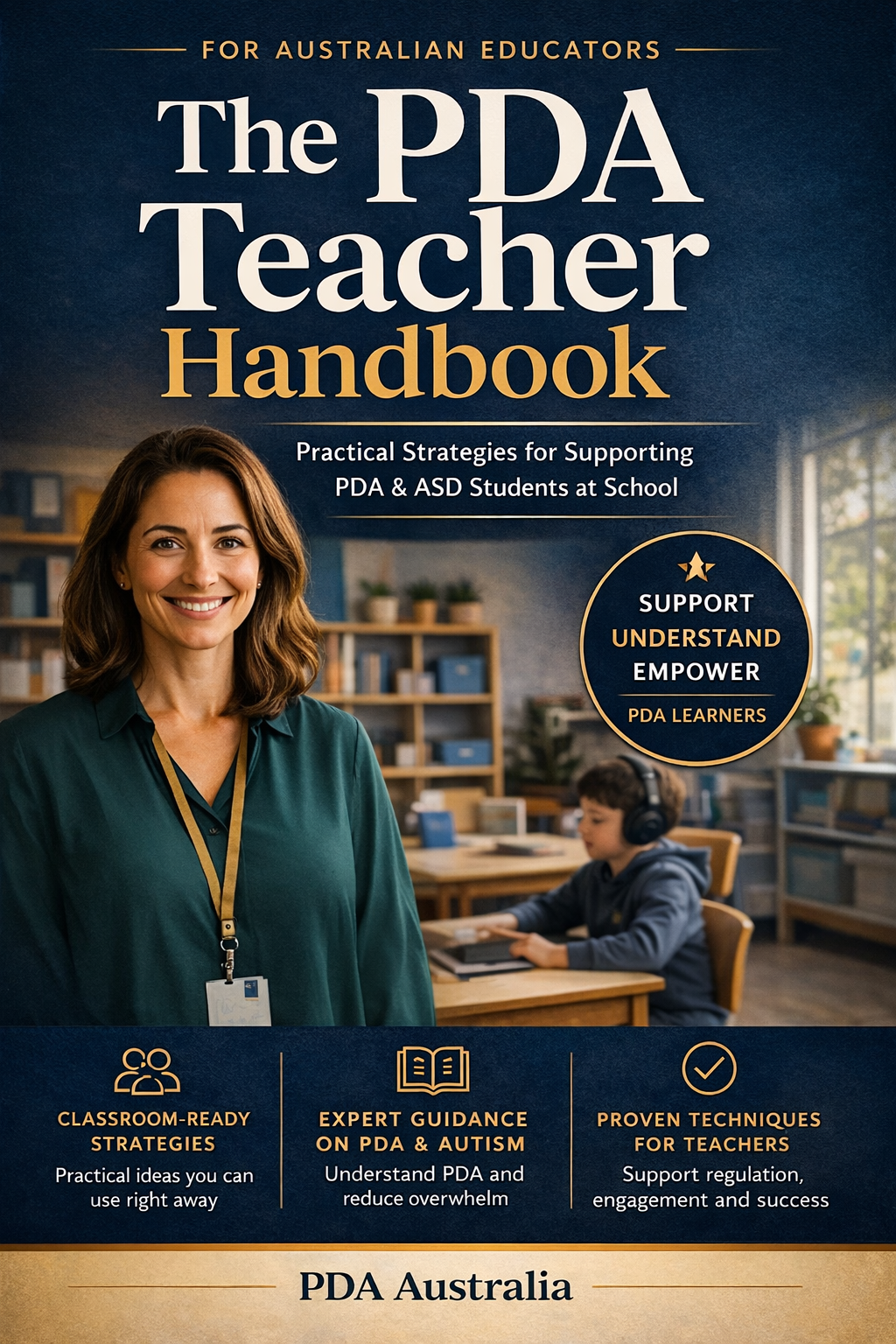
Ready for a complete classroom toolkit?
The PDA Teacher Handbook turns principles into daily practice.
A practical digital guide for educators who want to reduce escalation, build trust-based engagement and support PDA students within Australian school systems. Licence it for one classroom, or for every teacher on staff.
- Demand-aware classroom strategies
- Practical language and adjustments
- Printable school tools and templates
- Single or whole-school licence
General educational information only. Individual needs, school policies and legal requirements vary and can change. Consult the student and family, check current guidance and seek individual advice where needed.