
Support & services
Find support that fits the person—not just the label.
The right support should make life feel safer, more understandable and more sustainable. Use this practical hub to choose PDA-aware professionals, prepare for first contact and find Australian support for carers and urgent moments.
- Australian services
- PDA-aware questions
- Verified help contacts

Begin with today’s need
You do not need to solve the whole support system at once.
Choose the path that best matches what is happening now. Each one leads to a practical next step.
Find a professional who understands demand sensitivity
Compare approach—not just qualifications—and ask how safety, autonomy and consent shape their work.
Choose a professional →Start with practical support you can use now
Use free guides and low-demand strategies while you decide what longer-term support may help.
Browse practical resources →Go directly to urgent and crisis support
If safety is at risk or caring is no longer sustainable, use the verified Australian contacts below.
Find help now →Finding PDA-aware professionals
Choose for approach, not familiarity alone.
A provider may recognise the term PDA and still work in ways that increase pressure. Ask how their understanding changes what they actually do when a person is anxious, avoids, shuts down or says no.
Psychology & mental health
Look for acceptance-based, autonomy-supporting and low-demand practice. Support should reduce shame and build safety—not make compliance the measure of progress.
Occupational therapy
A PDA-aware OT should work at the person’s pace, explore sensory and daily-life barriers, and prioritise meaningful participation over task completion.
Behaviour support
Ask how the practitioner understands behaviour as communication. Plans should be rights-respecting, non-punitive and focused on reducing distress and environmental mismatch.
Support coordination
A strong coordinator can help locate suitable providers, organise the support team and advocate when a standard service model is not a workable fit.
Important: A professional title does not guarantee a PDA-aware approach. Fit, consent and the person’s felt safety remain central.
A four-question fit check
Ask before you invest time, money and trust.
You are allowed to ask direct questions, request examples and decide that a provider is not the right fit. Their response to being questioned is information too.
How do you understand the PDA profile?
Listen for an explanation that includes nervous-system threat, autonomy, variability and the effect of demands—not simply oppositional behaviour.
What does low-demand practice look like in a session?
Ask for a concrete example. Good answers may mention choice, pacing, flexible goals, indirect language and permission to pause or leave.
What happens when the person says no?
A refusal should create curiosity and adjustment. Be cautious if the response centres consequences, rewards, planned ignoring or pushing through distress.
How will we review whether support is helping?
Progress might mean more safety, trust, recovery, communication or sustainable participation—not simply greater outward compliance.
Encouraging signs
Curiosity, flexibility and shared power
The provider listens to lived experience, adapts the environment, welcomes family context and includes the person in decisions.
Pause and reconsider
Compliance is treated as the outcome
Be cautious when distress is minimised, family reports are dismissed, or rewards, consequences and exposure to demands are the default response.
Before the first appointment
Make the first contact do some of the filtering.
A short message can explain what matters and invite the provider to show how they work. You do not need to present the whole history just to ask whether the approach may fit.
Bring a one-page snapshot
- What the person wants help with
- What increases demand or threat
- What helps them feel safe and communicate
- What recovery looks like after appointments
- How they want to participate in decisions
For parents and carers
The support plan needs to include you.
Carer exhaustion is not a personal failure. Sustained advocacy, interrupted sleep, crisis prevention and system navigation all carry a cost. Practical and financial support may be available.
Carer Gateway
Free counselling, coaching, peer support and respite pathways for unpaid carers.
Visit Carer Gateway ↗ 02Financial supportCarer payments
Check current eligibility information for Carer Payment, Carer Allowance and related support.
Check Services Australia ↗ 03Practical reliefPlanned or emergency respite
Explore local respite options or call Carer Gateway when you suddenly cannot continue caring.
View respite support ↗Urgent help
You do not need perfect words to reach out.
If someone is in immediate danger or requires urgent medical help, call Triple Zero (000).
This page is not a crisis, clinical or emergency service. Contact details were checked against official service information.Lifeline
24/7 crisis support for anyone in Australia
Kids Helpline
Free 24/7 counselling for ages 5–25
Beyond Blue
24/7 phone and webchat support
Carer Gateway
Planned or emergency respite options
Start free
Use a practical resource while you build the wider support team.
Download tools, learn the PDA framework and prepare clearer conversations without waiting for an appointment.
Free PDA resource library
Printable guides, checklists, scripts and templates for home, school and NDIS planning.
Browse free resources → Learn & reflectPDA articles and strategies
Clear explanations, lived-experience perspectives and practical Australian guidance.
Read PDA articles → Build evidenceNDIS & PDA resource hub
Organise functional impact, prepare for planning and understand the support process.
Explore NDIS support →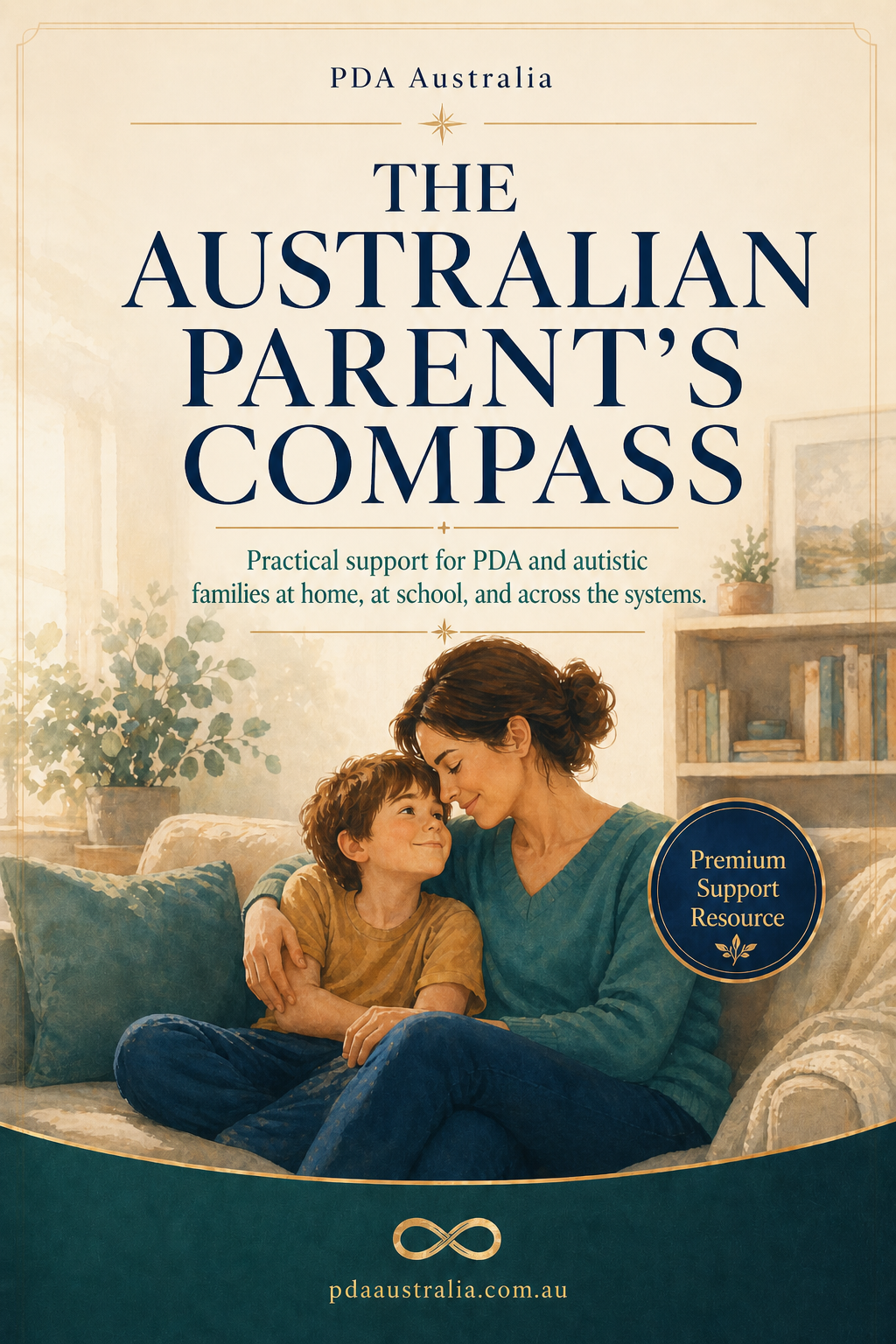
Ready for a complete pathway?
You do not need another parenting rulebook. You need a compass.
The Australian Parent’s Compass connects nervous-system understanding with practical support for home, school, NDIS and family life.
- 136-page digital guide
- Nine connected chapters
- 21 printable tools
- Australian context
Instant digital guide$37 AUD
View the Parent’s Compass ↗Instant download from PDA Australia.