Make the plan tell the whole story.
PDA support needs can be real, substantial and easy to miss in a short appointment. This practical hub helps you document daily functional impact, organise useful evidence and prepare for the next NDIS conversation with more clarity.
- Australian context
- PDA-aware
- Plain-language tools

Start with function
A diagnosis opens the conversation. Daily impact tells the story.
NDIS access is assessed against eligibility requirements. A diagnosis or PDA label does not guarantee access on its own; evidence needs to explain the disability and its effect on everyday functioning.
Check current NDIA evidence guidance ↗What happens without support
Describe the assistance already happening behind the scenes, then show what becomes unsafe, inaccessible or unsustainable when it is removed.
Capacity across settings
A calm appointment can miss the cost of school, self-care, community access and recovery. Bring evidence from the places daily life actually happens.
Frequency, duration and recovery
Replace broad phrases with concrete patterns: how often support is needed, how long tasks take and how much recovery follows.
Fluctuating capacity
Record the pattern across good, difficult and typical days. Doing something once, or in ideal conditions, is not the same as doing it reliably and independently.
Masking and delayed release
Connect the outwardly capable presentation with the later shutdown, distress, absence or loss of function that may follow sustained demands.
The family support load
Name the prompting, co-regulation, supervision, transport, recovery time and environmental adaptation that make participation possible.
A useful evidence pattern
Turn “they struggle” into a picture someone can understand.
A strong example connects the situation, the support provided and the functional outcome. It also explains the counterfactual: what happens when that support is not available.
-
1
Context
What was happening, where, and what demand or barrier was present?
-
2
Support
What prompting, co-regulation, adaptation or supervision was needed?
-
3
Outcome
What became possible, safer or more sustainable because of that support?
-
4
Without it
What typically happens when the support is unavailable or the demand load rises?
Choose the stage you are in
Take the next useful step—not every step at once.
The evidence changes as the decision changes. Start with the pathway that matches what is in front of you now.
Applying for access
Build the evidence before the form
- Check the current access requirements on the NDIA website.
- Collect diagnostic and functional evidence from relevant professionals.
- Add a parent, carer or personal statement grounded in daily examples.
Preparing the plan
Link goals, function and support
- Bring a short written summary rather than relying on memory under pressure.
- Explain how each requested support changes functional outcomes.
- Ask for questions or decisions you do not understand to be clarified.
Reviewing a decision
Respond to the reasons given
- Read the written decision and identify exactly what was refused or changed.
- Match new evidence to the decision-maker’s stated reasons.
- Act promptly: review pathways have strict time limits.
Before the conversation
Bring a one-page map of what matters.
A planning meeting is not the place to discover your clearest examples. Prepare them while there is time to think, check and involve the person whose plan it is.
Keep the participant’s preferences, voice and goals central. Where possible, agree in advance how they want to contribute and what support they need during the meeting.
-
01
What a typical week requires
Include daily support, appointments, school or work, recovery and community access.
-
02
The three biggest functional barriers
Use specific current examples from more than one setting.
-
03
What is already helping
Name the support, frequency, who provides it and the observable outcome.
-
04
Where the current gap sits
Show the unmet need, risk or unsustainable informal support load.
-
05
The goal each support connects to
Keep goals meaningful to the participant rather than service-shaped.
-
06
Your questions before the meeting ends
Record anything unclear, any follow-up evidence and the next contact point.
When the decision does not fit
Read the reasons. Protect the deadline. Answer the gap.
A review is strongest when it responds to the actual written decision. Ask for an explanation if needed, organise evidence around the disputed point and seek advocacy or legal help early.
First
Read the written decision
Identify the exact decision, the reasons given and what different outcome you are seeking.
Internal review
Request within 3 months
The NDIA says you must ask within three months from the day you receive the initial written decision.
External review
ART can review the outcome
After an internal review decision, the Administrative Review Tribunal is the external review pathway.
Current NDIA guidance: the NDIA aims to complete internal reviews within 60 days. Its current guidance says an ART application is generally due within 28 days after the internal review is completed.
Check the current review process ↗Free PDA Australia downloads
Use the tool that matches today’s job.
Free PDF · instant download · no email required
NDIS Access Checklist for PDA Families
Confirm the documents, evidence and practical steps to organise before applying.
Access Download ↓NDIS Application Template Pack
A structured starting point for turning daily functional impact into a clear application.
Templates Download ↓NDIS Functional Evidence Brief
Share this with treating professionals to support specific, useful functional reporting.
Professionals Download ↓NDIS Goal Bank for PDA Children
Practical goal language that keeps participation, safety and independence in view.
Goals Download ↓NDIS Plan Review Preparation Checklist
Walk into a plan reassessment or review with your evidence and questions organised.
Review Download ↓NDIS Plan Implementation Guide
Turn an approved plan into coordinated supports that are actually delivered.
After approval Download ↓Need a different tool? Browse all NDIS & Funding downloads in the full free resource library.
Explore all free resources ↗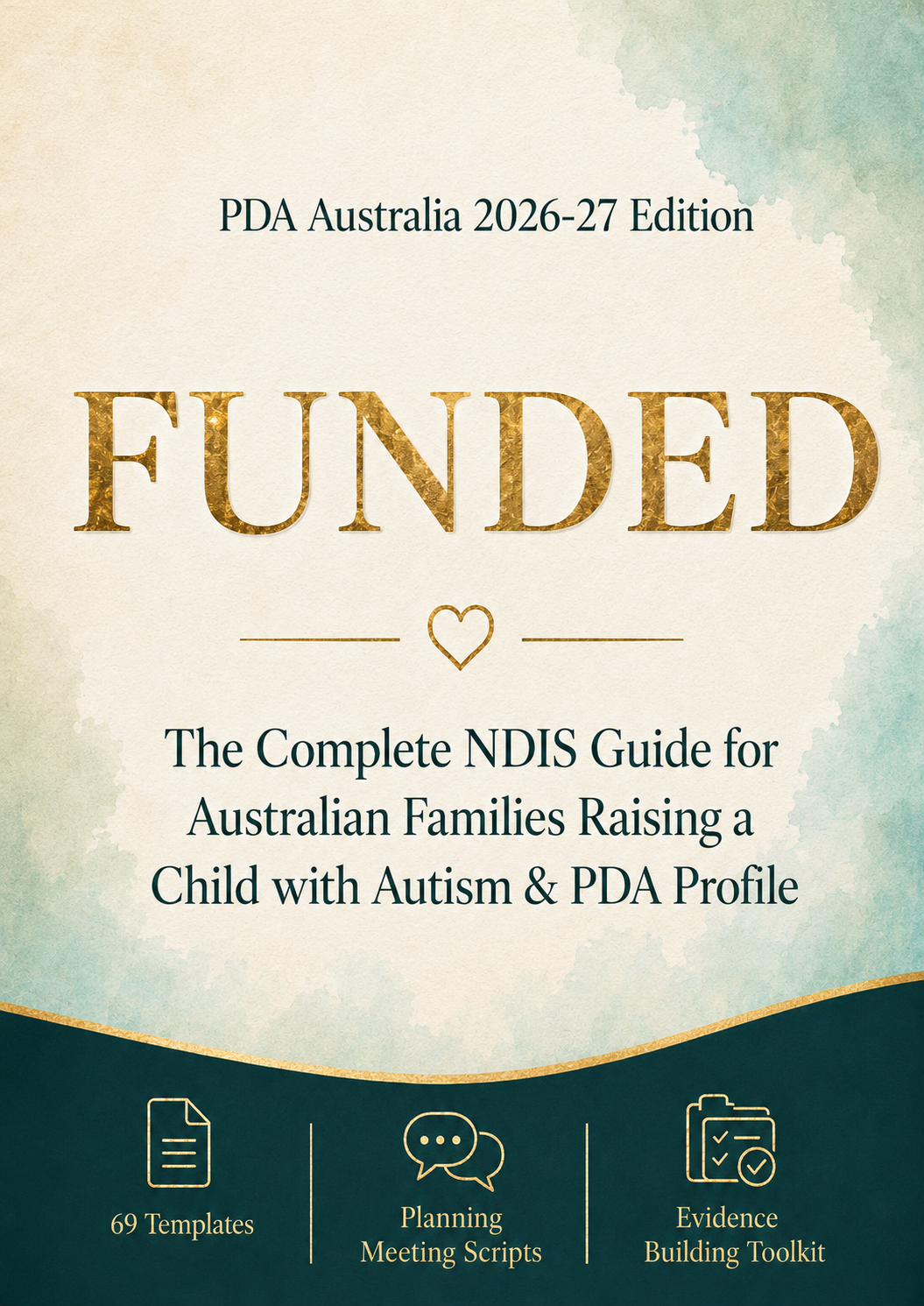
Ready for the complete pathway?
FUNDED brings the whole process into one working system.
Built for Australian families raising a child with an autism and PDA profile, with practical structure for preparing, protecting or rebuilding NDIS funding.
- 69 fill-in templates
- Planning meeting scripts
- Evidence-building toolkit
- 2026–27 edition