
Build a life that works with your nervous system.
PDA in adulthood can look less like “refusal” and more like a lifetime of negotiating with work, relationships, appointments, self-care and even the things you want to do. Start with recognition, remove the moral judgement and design for the capacity you actually have.
- Adult-centred
- Australian context
- No diagnosis required to begin reflecting

Recognition without judgement
The outside story may miss the nervous-system load.
Adult demands are often quieter than childhood demands, but they are everywhere: calendars, unread messages, bills, expectations, decisions and the pressure to be consistent. These patterns are not a checklist or diagnosis. They are prompts for understanding what changes access to your own capacity.
Capability is not consistency
You may do something well once, in the right conditions, and still be unable to access that capacity reliably or on demand.
Wanted tasks can still become demands
Interest does not always override threat. Work, hobbies, messages and self-care can become harder the moment they feel compulsory.
Masking can hide the cost
Others may see competence while you are using intense effort to perform, script, monitor and recover from ordinary participation.
Transitions carry their own load
Starting, stopping, switching focus, leaving home or moving between roles may use more capacity than the task itself.
Autonomy can restore access
Choice over timing, method, pace and communication can change whether a demand feels possible—not because you need control over others.
Recovery debt accumulates
Pushing through can work temporarily while borrowing from the next hour, day or week. The delayed cost still belongs in the picture.
Interrupt the shame loop
The demand can come from outside, inside—or something you genuinely want.
Understanding the sequence creates more choices. The aim is not to eliminate every demand or never feel discomfort. It is to notice the pressure earlier, reduce unnecessary threat and stop treating a nervous-system response as proof of personal failure.
Read: how PDA can show up in adult life ↗- 1A demand registers
It may come from another person, a deadline, your body, or your own plan.
- 2Threat rises
Urgency, loss of control or anticipated evaluation can narrow access to thinking.
- 3Access changes
You might avoid, negotiate, freeze, over-control, distract or push through at a cost.
- 4Shame adds another demand
Self-criticism increases pressure and makes the next attempt harder to approach.
Daily life
Reduce friction without making your whole life smaller.
Useful support preserves agency and makes capacity easier to access. Start with one recurring pressure point rather than turning self-understanding into another complete life overhaul.
Make optionality visible
Create a real route in—not a disguised instruction
- Choose the order, location, timing or smallest useful version.
- Separate what must happen today from what can wait or be dropped.
- Use genuine alternatives; a forced binary can still feel like one demand.
Externalise without policing
Let systems hold information, not authority
- Use visible lists, timers or calendars as neutral information sources.
- Keep prompts editable so they do not become another person directing you.
- Prepare scripts for calls, forms and appointments before capacity is low.
Budget for the whole cost
Plan the recovery as carefully as the task
- Count travel, transitions, social performance and recovery—not only task time.
- Protect blank space after high-demand events before the calendar fills it.
- Reduce the plan early rather than waiting until your body makes the decision.
Work and adjustments
Change the conditions before concluding you cannot work.
Sustainable work is not only about the role. Autonomy, predictability, communication, sensory conditions and recovery can determine whether your skills are accessible. Ask for the change that addresses the actual barrier.
Explore workplace adjustments with JobAccess ↗- 01Autonomy in method
Agree on the outcome while allowing choice in task order, process and problem-solving approach.
- 02Written and asynchronous communication
Use written priorities, fewer spontaneous calls and time to process before responding.
- 03Predictable priorities
Clarify what is truly urgent, preview change and avoid several people redirecting work at once.
- 04Flexible time and location
Explore adjusted hours, remote work, quieter periods, recovery breaks or a gradual workload.
- 05Sensory access
Reduce noise, lighting, interruption and unnecessary social exposure where practical.
- 06Output over performance
Assess the work produced instead of visibility, eye contact, constant availability or one fixed process.
Need words for the conversation? Use the free workplace accommodation scripts.
Download FD68 →Relationships
Connection works better without hidden tests.
Love, care and good intent do not make demands stop feeling like demands. Clear agreements can reduce mind-reading, protect both people’s needs and make space for repair.
Offer instead of cornering
Where there is flexibility, make it explicit. “Would tonight or tomorrow suit?” is different from a request that only sounds optional.
Name capacity early
Short, agreed language such as “I want to respond, but I cannot process this now” can prevent silence being read as indifference.
Do not personalise every pause
Withdrawal may be recovery from demand accumulation. Agree on when and how you will reconnect so both people have clarity.
Repair without a courtroom
After overload, focus on impact, care and what to change next time—not proving whose interpretation was correct.
Recognition and assessment
You can explore the pattern before deciding what formal recognition means for you.
Self-reflection and formal assessment answer different needs. There is no single emotionally correct next step. Consider what you want from the process, what it may cost in money and capacity, and what support you need around it.
Exploring privately
Build a kinder working hypothesis.
- Read adult-lived-experience material without forcing a conclusion.
- Track what changes capacity across work, home and relationships.
- Look across your life history, including adaptations others may not see.
- Try low-risk supports now and notice what genuinely helps.
Seeking formal assessment
Choose the purpose before the provider.
- Clarify whether you want answers, documentation, treatment context or service access.
- Look for an adult autism clinician who understands masking and demand avoidance.
- Ask what evidence, developmental history and informant input they require.
- Plan for the demand and emotional load before, during and after appointments.
These resources cannot diagnose PDA or autism. A qualified clinician can discuss formal adult autism assessment and whether PDA-informed language is useful in understanding your individual presentation.
Free adult downloads
Choose the resource that meets you where you are.
Free, printable PDA Australia resources. No signup required.
PDA Adults Self-Assessment
Reflective prompts for considering whether PDA patterns fit your experience.
Free PDFDownload ↗Discovering Your PDA Profile as an Adult
A grounded companion for the relief, grief and rethinking that can follow recognition.
Free PDFDownload ↗Adult PDA Assessment Guide
Understand what an adult assessment may involve and how to prepare your history and questions.
Free PDFDownload ↗Rest & Recovery for PDA Adults
Build sustainable recovery into ordinary weeks instead of waiting for crisis.
Free PDFDownload ↗PDA at Work
Practical ways to reduce demand load and make employment more sustainable.
Free PDFDownload ↗PDA and Relationships
Explore how demand dynamics affect connection and how to design communication differently.
Free PDFDownload ↗Exploring NDIS access as an adult? Start with the adult access guide, then use the dedicated NDIS hub for current evidence and planning resources.
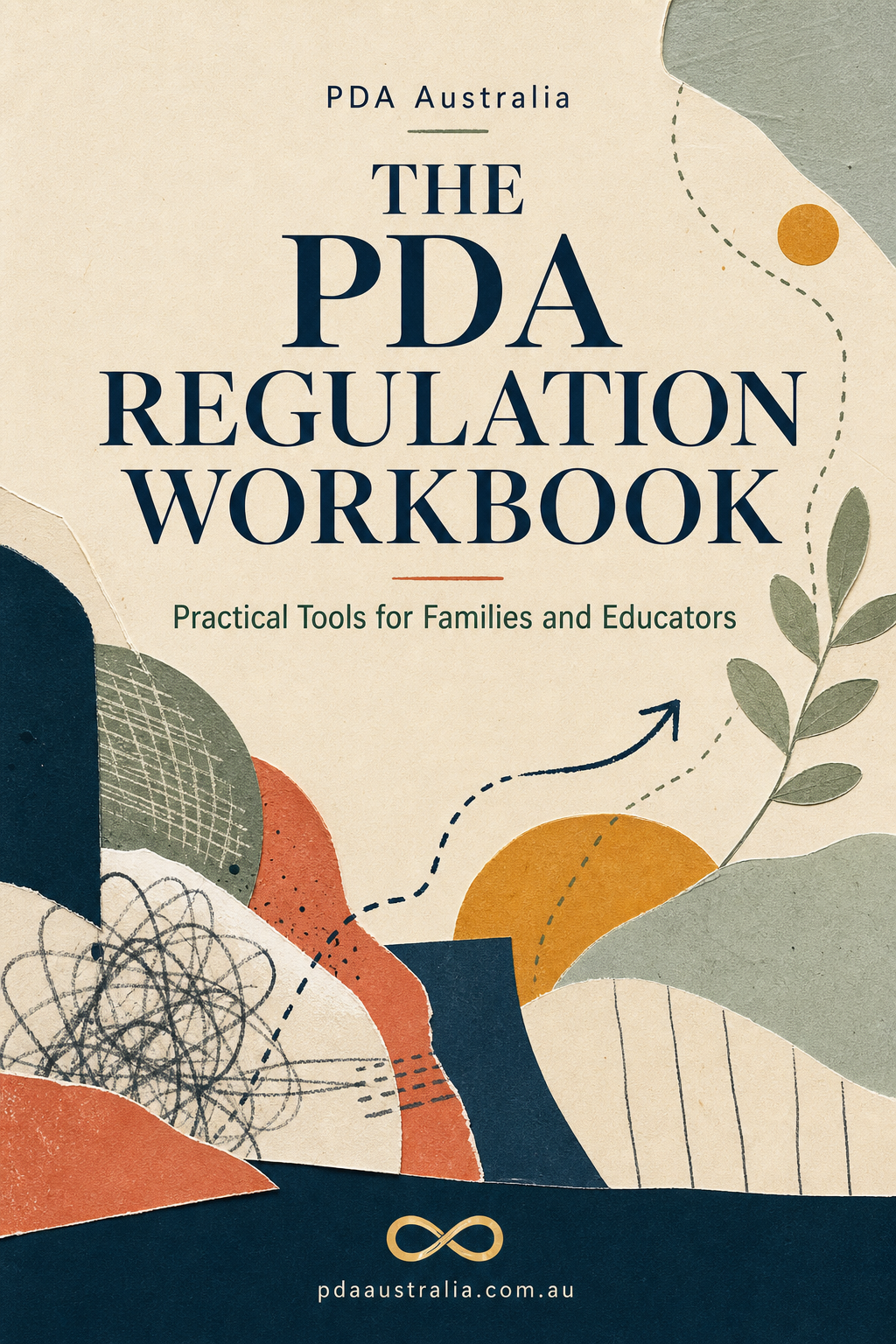
Also supporting someone with PDA?
Turn regulation observations into a practical support plan.
The PDA Regulation Workbook is a 102-page digital toolkit for families, educators and support professionals. Use it to map regulation zones, build body and sensory supports, notice burnout earlier and create a personalised one-page handover.
- 8 practical sections
- 10 printable worksheets
- Home and school environment audits
Instant digital workbook$17 AUD
View the Regulation Workbook ↗Instant download from PDA Australia.General educational information only. This page does not provide diagnosis, medical, psychological, employment, legal or individual NDIS advice. Needs and circumstances vary; seek appropriately qualified support where needed.